

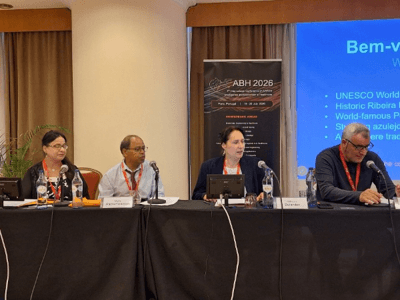
On 19–20 July 2026, Porto hosted the first International Conference on Artificial Intelligence and Blockchain in Healthcare (ABH 2026). Forti5 Technologies was closely involved: our Principal Research Consultant, Prof. Muthu Ramachandran, served as Conference Co-chair alongside Dr Kulvinder Panesar of the University of Bradford, with Gopal Singh Jamnal of Leeds Beckett University as Programme Chair.
Sponsored by INSTICC — the Institute for Systems and Technologies of Information, Control and Communication — and held in conjunction with the SIMULTECH and ICSBT conferences, ABH set itself an ambitious goal: to bring clinical experts and artificial intelligence (AI) experts into the same room, speaking the same language about the same patients. On the evidence of two days at the Vila Galé Porto, that goal was met.
Healthcare-AI events can settle into one of two camps — engineers talking to engineers, or clinicians talking to clinicians, with a glass wall in between. ABH 2026 was designed to break that wall, and across the two days a machine-learning method was never far from the bedside question it was meant to answer.
That showed most clearly in the breadth of clinical application papers. Delegates heard work spanning:
- Urology — a prediction model for differentiating overactive bladder from painful bladder syndrome, presented by Prof. Ramachandran, which wraps a strong ensemble classifier in Rough Set Theory so that genuinely uncertain cases are flagged for a specialist rather than forced into a label.
- Gastroenterology — applications in inflammatory bowel disease.
- Clinical microbiology — AI applied to diagnosis and antimicrobial stewardship.
- Mental health — supportive and monitoring tools built with privacy in mind.
- Continuous health and remote patient monitoring — turning streams of everyday data into earlier, safer decisions.
What united them was the order in which the question was asked: each began with a real clinical problem, and only then asked what AI could responsibly add. That is exactly the right way round.
Running beneath the applications was a second theme close to our work at Forti5: doing this well by design. Several of the eleven conference tracks — Governance by Design, AI Ethics by Design, Quality Assurance and Testing, and Regulatory and Policy Frameworks — put the emphasis where it belongs: not only on whether a model works, but on whether it is safe, fair, accountable and compliant from the first line of code. That design-first philosophy is the through-line of our own practice, and it was encouraging to see it treated as a first-class concern rather than an afterthought.
Keynotes from Paulo Nunes de Abreu (Health Data Forum), Prof. Victor Chang (Aston Business School, Aston University) and Prof. Feng Li (University of London) set the wider context. A short list of the best papers will be invited to post-conference special issues of Blockchain in Healthcare Today and Springer’s Health Information Science and Systems, with proceedings published by SCITEPRESS and submitted for evaluation for indexing by Scopus, Web of Science and others.
If there is one takeaway, it is this: the future of clinical AI will not be decided by clinicians or by AI specialists alone, but by the conversations between them. ABH 2026 created the space for exactly that conversation, and we are already looking forward to continuing it.
Our thanks to INSTICC, the SCITEVENTS team, the programme committee, and every author and delegate who made the inaugural ABH such a success. The second ABH takes place on 22–23 July 2027 in Rome — details at abh.scitevents.org.
Forti5 Technologies advises organisations on data protection, AI governance and cyber security. If you are building or deploying clinical AI and want it defensible from day one, get in touch.